
HACCP a Management Responsibility?
In 2006, EU Regulation EC No 852/2004 made HACCP law. As a result, the law requires the food business operator to ensure that HACCP principles are used making HACCP a management responsibility. In the food industry, HACCP has become an acronym that most people know as Hazard Analysis Critical Control Points (HACCP). Many of us have become involved in implementing and managing HACCP, the Food Safety Management System.
Since 1996, I have delivered HACCP training as it has evolved at Levels 2, 3, and 4.
Despite its importance, many in the food industry, including managers, supervisors, and operators, still do not understand how HACCP works and their responsibilities. Consequently, they are unfamiliar with the key jargon or the principles and their responsibilities.
During the HACCP training courses I have delivered over the years, it is still perceived (at the start) that HACCP is based on health and safety rather than food safety. This is because HACCP is based on completing risk assessments and considering the hazards (Microbiological, Physical-chemical, and allergens.
This article highlights how HACCP is a management responsibility, the implementation steps and the seven principles of HACCP, the legalities related to HACCP, and how HACCP should be applied in a food manufacturing environment.
Introducing HACCP.
Although the concept has existed since the 1950s, NASA’s space program developed the HACCP food safety system to ensure astronauts’ food safety. This system reduced the risk of food poisoning, which could have had severe consequences if astronauts suffered from diarrhoea and vomiting during their mission in space.
Before HACCP was introduced, many manufacturing organisations had completed end testing of food products. Through continued development, HACCP has adopted a proactive approach to prevent food poisoning. During the early 1990s, HACCP was developed and widely used as a voluntary or recommended standard until it was made mandatory in national food safety regulations.
The principles of HACCP were misunderstood in those early years. Although food safety management systems were developed, food preparation was not broken down to find which controls in the food production process were not essential because of the controls further along the production process that were in place to remove possible problems with the product produced.
Although the regulation became a legal requirement in January 2006, it was published in 2004, giving the industry two years to implement a system by that date. The regulation became mandatory with EU regulations on the hygiene of foodstuffs.
This regulation made it a management responsibility to ensure HACCP is implemented and used to meet the requirements of this regulation.
Contact Workforce Training”“food business operators shall put in place, implement and maintain a permanent procedure based on the HACCP principles”.
Regulation (EC)no 852/2004 0n the hygiene of food stuffs.
What is the ‘Terminology’ Used in a HACCP Plan?
To be able to work with HACCP, it is important to be aware of the ‘terminology’ or ‘jargon’ used as part of the Hazard Analysis Critical Control Points (HACCP) plan. This becomes part of what is known as part of the Food Safety Management System (FSMS). This system identifies, assesses and controls hazards significant to food safety.
As part of the FSMS, the policies and procedures of Good Manufacturing Practises (GMP), Good Hygiene Practises (GHP, FURTHER controls, and documentation are in place to ensure the food products produced by the food manufacturing business are safe to eat and free from contamination as the law requires, these are known as the prerequisite programmes (PRP). These PRPs form the solid foundations for any HACCP plan. Consequently the prerequisite programmes are in place before any HACCP plan is developed. In fact effective use and implementation of the prerequisite programmes will simplify the HACCP plan as they are used daily across the site, controlling the day-to-day hazards.
As part of the FSMS, a HACCP Plan is developed either as a ‘written document’ or ‘electronically’ (as required by law), creating and following the (7) principles of HACCP, ensuring the control of ‘significant hazards’ in the production of food products in the business.
“Hazard: Anything which may cause harm to your customers through eating the food you produce” Codex 2020.
The risk (in this case, food safety risk) is the likelihood of a hazard occurring in food. Risk assessment identifies possible hazards, considers their probability and severity, and then evaluates their significance. The steps in the progress where the hazards are assessed as significant become Critical control points (more about these in principle two).
When HACCP is first implemented in a business, there are eleven steps, including the seven principles. As part of the implementation process, the Prerequisite programmes are collated as a foundation. These programmes include good hygiene practices (GHP), good manufacturing practices (GMP) and policies, including training and traceability, that must be in place as they are essential to food safety.
It is very important to note HACCP is in place to ensure food is produced safely and reduces the food safety risk of harming or causing injury to the consumer. The food safety risk assessment identifies the food safety hazards and assesses the risks of the food safety hazards. Health and safety is not referred to or considered in HACCP.
The Implementation of HACCP is a management Responsibility.
Although HACCP is required by law, senior management must provide the resources to implement and manage it. Food product safety is primarily a management responsibility. As we know the food products produced in food manufacturing must be ‘fit for human consumption’.
For HACCP to be practical, its implementation must be planned throughout the production operation so everyone is familiar with it.
Assembly of a HACCP Team.
A HACCP team is formed to ensure the ‘HACCP plan’ is implemented and applied correctly, often including those with a high level of experience, knowledge, competency and training. The team work together to develop and implement a HACCP system. HACCP is based on controlling possible hazards in the production of food. Hazards are biological, chemical, physical, or allergens, all of which have the potential to cause harm to the consumer.
The HACCP team is usually a multi-discipline team proportionate to the size of the manufacturing process. People from across the food production process will become part of the team. Some will wear two hats in a smaller organisation. The HACCP team will have members aware of the different parts of production and the hazards, risk control monitoring, corrective actions and the technology used in the process control.
The Team leader is responsible for managing HACCP and will thoroughly understand HACCP and the production operation.
Usually, in food manufacturing, the team comprises a quality assurance or technologist, an engineer, a production
specialist, a manager who understands product packing and distribution, and a scribe who takes accurate notes
during HACCP team meetings.
Training the HACCP Team
For the HACCP plan to be effective, the team and those closely involved with the application should receive training.
As they drive the HACCP plan, the team should complete at least level 3, with the team leader possibly completing
level 4.
Those on the periphery should receive at least level 2 HACCP training.
Expert Training at Workforce Training
For many years I have successfully delivered HACCP training to many organisations in different sectors of the food industry.
At Workforce Training Highfield HACCP courses are delivered directly to employers at their site or as open public courses open to individuals or employees of organisations not able to facilitate the delivery of a training course on their own premises.
Our HACCP training courses are delivered at Level 2 Award in HACCP for Catering and Level 2 Award in HACCP for Manufacturing, Level 3 Award HACCP for Manufacturing, Level 3 Award in HACCP for Catering and Level 4 Award in HACCP for Manufacturing (Codex Principles) and Level 4 Award in HACCP for Catering (Codex Principles) .
In addition to the courses delivered face-to-face in the training room we offer HACCP online e-learning. Again these courses are written and developed by Highfield. On successful completion a certificate confirming HACCP training has been completed endorsed by Highfield is available immediately on having completed the training.
All our HACCP training courses have been written and developed by Highfield delivered by Workforce Training and then Certificates are issued endorsed by Highfield.
Contact Workforce Training for further information.
Describe the Products and Processes?
Products must be described with the recipes, ingredients, and sources of the raw materials. The potential hazards and risks that could be associated with them. The intended storage and any processes such as cooking or smoking, storage and how the products will be distributed. In addition, the intended storage (refrigerated or frozen) and shelf life are best before use-by dates and the format of these. Finally, the packaging, e.g. vacuum, food-safe film etc. The labelling instructions with the ingredients listed in percentages with the highest listed first. Any allergens should be listed in bold. The finished product storage process should be described, identifying how long the products must be refrigerated after completion.
Identify the End Users
The likely consumer should be considered. All groups of the end users will have vulnerable groups, such as babies and older people.
The abuse of the end user must be considered, such as leaving the product in the car on a hot day or while driving a long distance. The possibility of reheating the product and eating it hot must also be considered. Will it then be reheated again?
Constructing a Process Flow Diagram
This diagram is drawn up by the HACCP team, who, when constructing a flow diagram for the first time, will do so across the table. Inevitably, missing out vital steps in the manufacturing process leads to those steps not being part of the risk assessment. The flow diagram is constructed following the step-by-step process of the manufacturing process. This is where the diversity of the HACCP team can be used as each person’s expertise can contribute towards making the flow diagram accurate. The flow diagram must identify every step in the process. This starts with the raw materials arriving on site and their storage or immediate use preparation. All the processes must be added, including different ingredients and water. The removal of packaging or reworked product where packaging comes into the process, and if there is external packaging, how is this removed?
As the HACCP team develop the process flow diagram, they should collate important details about storage time or cooking or blast chilling times and temperature.
Once all this is complete, the HACCP team should validate the process flow diagram by walking through it. This will then recognise the process steps missed out. The flow diagram must then be corrected. Walking the process several times on each shift, especially on the night shift, is good practice. This ensures the process flow is now correct on each shift, maximising the effectiveness of the flow diagram and the HACCP plan.
The 7 Principles of HACCP
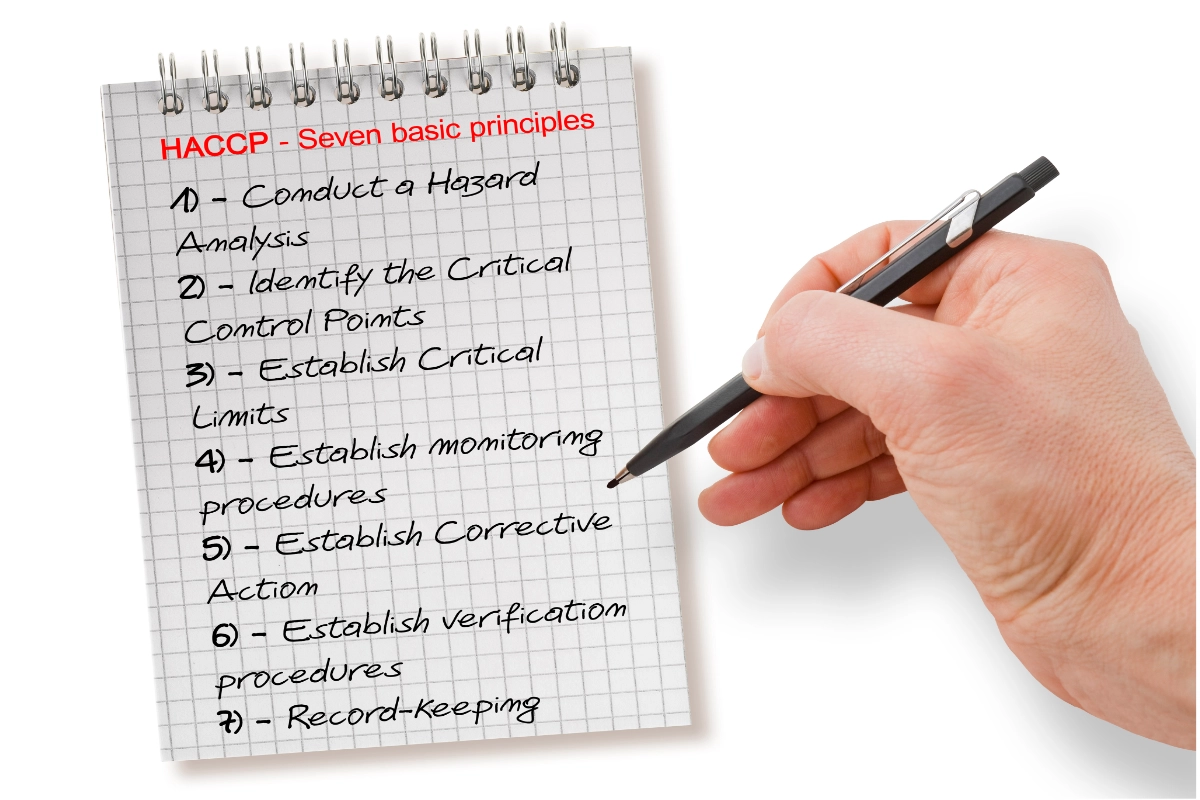
HACCP is a set of seven (7) principles that create a framework for conducting a risk assessment and identifying critical control points (CCPs) where control of a hazard is essential.
These CCPs can then be monitored to ensure that risk is minimised and that immediate action can be taken if a hazard becomes present.
When using HACCP there are seven principles to use to make the system effective and efficient:
Conduct a Hazard Analysis (Principle 1)
As with most risk assessment processes, the first step of HACCP is to establish all food safety hazards in the different production areas as the product is processed right from the start of picking the full range of raw materials and ingredients and ensure that food safety standards are adhered to. This means walking the process flow and observing not only the process flow but the activity around the main production line, such as using blue gloves if required, wearing beard snoods, etc. The use of knowledge and judgement anticipating what could go wrong, making a food product unsafe for someone to consume.
HACCP is centred on physical, biological, and chemical hazards, with biohazards being the main focus. These include foodborne illnesses, cleaning products, and physical contaminants in the food.
Determine the Critical Control Points (CCPs) (Principle 2)
The critical control points (CCPs) are the steps in the process where
‘control measures are essential to eliminate or reduce the hazard to an acceptable level’.
Failure to apply the control measures effectively may harm or injure the end consumer. A document called a ‘decision tree’ is usually used to determine each CCP using the the expertise, skill, and knowledge of those in the HACCP team. The decision tree is a diagram of structured questions to determine whether a step in the process is a control or critical control point—expertise, skill, and knowledge of the HACCP team. The decision tree is a diagram of structured questions. For instance, meat preparation is a control point. When the meat is cooked, it will be determined as a CCP using the decision tree. The decision tree will also determine whether a piece of meat has been cooked and for how long. Additional training and adequate supervision are advised for those who may work at each CCP, for instance, on each shift. When each CCP is determined, it is good practice to record its justification. Once completed, this principle will result in several justified CCPs that will require additional focus on each of these process steps, with monitoring, corrective actions, and verification and validation procedures put in place as part of the FSMS.
Establish Validated Critical Limits for Each CCP (principle 3)
When the HACCP team establishes the CCPs, validated critical limits must be established. These are put in place where the CCPs have been established. Critical limits must be measurable, and the results obtained must be as close as possible to that step in the process of the control measure—for example, temperature, time, viscosity, and physical parameters, including the weight and size of the product. Bacteriological sampling is usually not determined as the results typically take several days.
As part of the critical limit, usually, a tolerance is set slightly above and below. This enables a potential breach of the critical limit to be detected and corrected before the food becomes unsafe and needs to be either downgraded or destroyed.
An example is the refrigerated storage of a high-risk food that could be 8 degrees for 4 hours. If this critical limit were breached, then the food would need to be destroyed; however if the target level is breached, a corrective action would be taken before it is b reached. Adjusting the thermostat may be the only action required to bring the process under control.
Monitoring of Control Measures at Each CCP (Principle 4)
Monitoring or the checking of the critical control points (CCPs) is important to confirm the manufacturing process is under control and the control limits are not being breached. Whichever way of monitoring each CCP is used whether observation or taking a measurement (temperature) the result of the monitoring must be almost instant to avoid the breach of the control limits resulting in the requirement to find the reason for the dieviation.
Begging the question ‘am I in control of this process?
The monitoring processes in place should ask What are the critical limits and target levels? How is the monitoring of the control limits completed? wWhen should the monitoring be completed?
Establish Corrective Actions (Principle 5)
Corrective actioin is the action taken when a control is breached. The corrective action is split into two important parts. Dealing with the affected product then bringing the critical control point and process back under control and importantly preventing the breach happening again.
Procedures for corrective actions should specify the required action, the person responsible for taking the action and to whom this must be reported.Management or the HACCP tream leader usually make a decision on stopping production and when this can be resterted normally after ensuring the corrective action has been confirmed.
If the critical limit is breached the product there are several ways the product can be dealt with. The product can be witheld and placed in quarantine. It is important the product is stored correctly and labelled as quarantined. Samples of the product can then be taken and sent to the lab for micro analysis. However this cannot be done for short life products. Another alternative is to inspect the product and as an example the product cooking time could be extended to ensure the product is properley cooked as the temperature had not been reached at the CCP and so the critical limit had been breached. Alternatively the shelf life could be reduced from five days to three days or the product could be down graded from a premiium product to an everyday/essential product. Should the product b e found to be unsuitable or unsafe to take any of these actions the product will need to be destroyed.
Supervisors and management normally make the final decision. They have important responsibilities reegarding their role in the implementation of HACCP. As once a critical limit has been breached the supervisiors and management will need to revisit the root cause for the breach and take the appropriate action to avoid this happening again.
If a product is and later found to be unsafe for the end user the product will need to be recalled. Therefore it is important the labels are clear and the product is fully traceable. Recalls are very expensive as the recalled product is returned and has to be replaced at no cost to the customer. In fact xvery often the customer will demand compensation for lost sales.
Validate the HACCP Plan and Establish Verification Procedures (Principle 6)
Perhaps the most important principle is to validate the HACCP plan is working effectively controlling the hazards identified through the process of developing the HACCP plan. Usually the validation process is completed as a trial period of the HACCP plan. As part of the validation process the CCPsand the PRPs are validated. As an example in manufacturing process the time and temperature link for cooking meat from raw with a minimum temperature of 75 degrees being met. The timing will vary as the meat may be a piece of meat or meat product.
Verification has two parts , are personnel completing the monitoring procedures as set out in the HACCP plan and Prerequisite Programmes (PRPs)/ Operational Prerequisitite programmes (OPRs). The second part is ensuring the required food safety standards are being achieved.
The frequency of the verification process this can be confirmed by examining the monitoring records. Verification should build confidence in the HACCP plan (was I in control)? The verification of the HACCP plan will then ensure the product is providing safe food.
Establish Documentation and Record Keeping (Principle 7)
Documentation used as part of HACCP should be proportionate to the size and complexity of the food manufacturing process. You’ll need to complete documentation at the appropriate time with a signature and date to complete the information. Providing the documentation is entirely and accurately completed, the documents are helpful to support a due-diligence defence if required in court.
Management uses Completed records in different ways, including investigating complaints, when the organisation is being inspected or when audited records will be called. The documented HAACP plan and the prerequisites should be kept in a hard copy manual or electronic format (probably both). Documentation includes the HACCP plan and the prerequisite programmes.
It is good practice and helps maintain the HACCP plan for each document to have the title and name of the person who developed and validated the document together with the version number and date.
The documentation developed and completed demonstrates that food safety is being correctly managed.
Reviewing the HACCP Plan
The HACCP plan should be reviewed periodically but at least once per year. It should not be developed and put into a manual format, then left on the top shelf and forgotten until required. The HACCP plan should be regularly reviewed and updated. It is almost used as a living documented system.
There are many different reasons to review the HACCP plan;
The introduction of a new product or a change to the current process.
The introduction of new machinery or the use of new scientific information. Perhaps a new computer-operated oven.
A change to a recipe using raw material from a new supplier, such as sugar or salt, is either removed or reduced.
It is essential to document the verification of the HACCP plan in detail, particularly all changes made to the plan by whom and on what date. This demonstrates that the plan is correctly implemented, reduces the risk of contaminated food products, and is maintained as a working document.
Summary
Wherever food is produced, many possible hazards can occur in food manufacturing. The HACCP system has evolved over many years to become the internationally recognised system to implement to reduce hazards to a safe level, reducing the risk of harm or injury to the end consumer. All staff can be involved with product safety, which develops a positive food safety culture.
Using HACCP correctly reduces the business’s risk, demonstrating management’s commitment to creating customer confidence and product safety. As the system is proactive rather than reactive, remedial action can be taken during the production process, as the operation of HACCP is controlled on the premises. As a result, HACCP is cost-effective as it focuses resources on the critical control points, reducing the need for end product testing. Reducing expensive rework, wastage, complaints and recalls.
The HACCP system complies with legal requirements and auditors’ and inspectors’ requirements. Effective implementation is useful in demonstrating due diligence under U.K. law.
Most importantly, the system must be implemented effectively, giving so many of the above advantages.
The food industry has several guides available to comply with regulations. For example, the Catering Industry has a freely available guide to good food hygiene.